
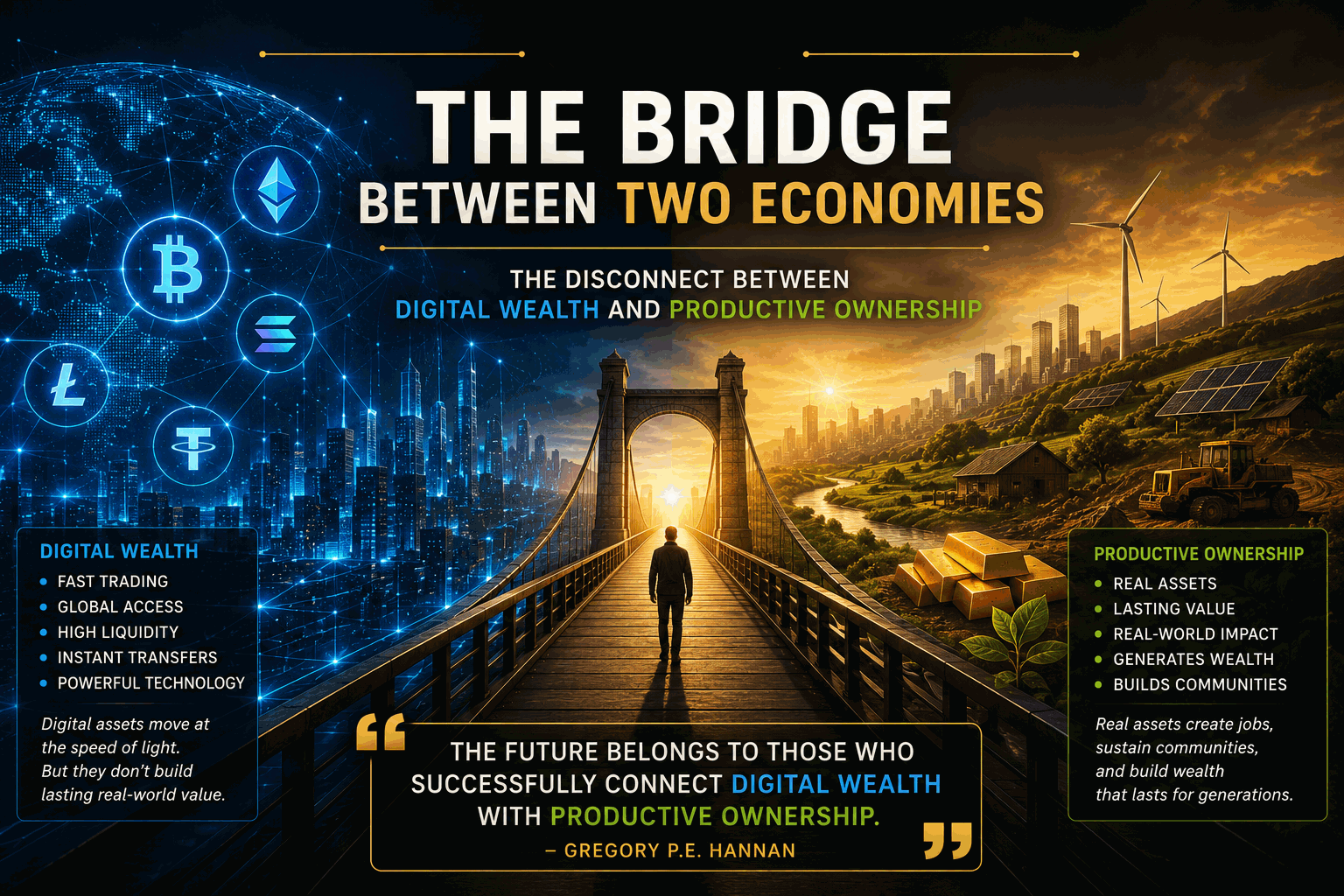
The Evolution of Wealth in the Digital Age
Every generation inherits a different definition of wealth.
For thousands of years, wealth was measured by ownership of productive land, precious metals, thriving businesses, natural resources, and agricultural enterprises. These were tangible assets that produced income, preserved purchasing power, and could be passed from one generation to the next.
he twentieth century transformed the investment landscape. Paper currencies, stock exchanges, managed funds, banking systems, and electronic commerce enabled wealth to move faster and across greater distances than ever before. Investors no longer needed to physically possess their assets; ownership itself became increasingly digital.
The twenty-first century has taken that transformation one step further.
Blockchain technology and cryptocurrency have created an entirely new form of wealth. Millions of people around the world now own digital assets capable of being transferred globally within minutes, without relying on traditional financial institutions. Cryptocurrency has challenged long-held assumptions about money, payments, ownership, and international commerce.
Yet despite this remarkable innovation, one important challenge remains.
How can digital wealth be transformed into ownership of productive real-world assets?
While cryptocurrency markets provide sophisticated platforms for buying, selling, and exchanging digital currencies, comparatively few pathways exist for investors wishing to convert their digital wealth directly into tangible assets such as precious metals, environmental investments, agricultural enterprises, or other productive opportunities without first returning to the traditional fiat banking system.
It is this challenge that inspired the creation of MainStreet Money (MSM).
MainStreet Money is more than a customer relationship management platform or digital marketplace. It represents a practical framework for connecting blockchain technology with productive ownership. Through carefully structured commercial relationships, blockchain technology, tokenisation, and fractional ownership, the platform seeks to provide cryptocurrency holders with new opportunities to exchange selected digital assets for real-world products, services, and investment opportunities.
Rather than viewing cryptocurrency as the destination, MainStreet Money views it as a bridge—a means of connecting the rapidly expanding digital economy with industries that create enduring economic value. These include precious metals, carbon markets, regenerative agriculture, agri-wellness enterprises, property-related opportunities, and other productive assets capable of generating long-term wealth.
This article is but a taste of the content of a book of the same name, Main Street Money in which you will discover that the future of investing may not lie in choosing between traditional assets and digital assets, but in combining the strengths of both.
You will explore how blockchain technology, tokenisation, fractional ownership, and commercial partnerships are reshaping investment opportunities that were once available only to institutions or high-net-worth investors. More importantly, you will see how these innovations may enable everyday investors to build diversified portfolios of productive assets using the digital currencies they already own.
This is not simply a book about cryptocurrency.
Nor is it merely a guide to blockchain technology.
It is a book about the next evolution of wealth creation.
It is about transforming digital value into productive ownership.
It is about connecting innovation with tangible opportunity.
And ultimately, it is about building investment portfolios designed not only for today’s economy, but for future generations.
Welcome to MainStreet Money—where digital wealth meets the real world.
An Article By
Gregory P.E. Hannan
Author: Main Street Money